EXTRA! PHOTO GALLERY BELOW
SPEAKER
National Drug Policy as it Relates to Marijuana
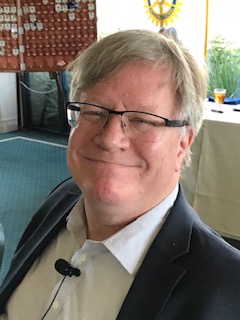 Robert J. MacCoun
Professor of Law, Stanford University
Senior Fellow, Freeman Spogli Institute
The author of more than 150 books and articles about the psychology of risk, public policy and the legal and illegal drug trade began his presentation with a recollection of his last Rotary meeting, 55 years ago, in which his father and other Rotarians lifted their shirts to reveal eyeballs painted on their chests, lips painted on their belly buttons and moved their bodies to the tune, “Whistle While You Work.”
We’ll put that one on Anne Campbell’s agenda.
How the U.S. regulates psychoactive drugs is an important issue at the moment because of the imminent explosion of the marijuana industry.
“If we don’t do it now, it will be very difficult later,” he said, when major companies will have consolidated the market and the billions in cash flow they will handle will allow growers and sellers to amass a PR and Congressional lobbying apparatus to rival the NRA and the cigarette industry.
He’s not sure if it will happen but said it’s “possible” that states legalizing sale of recreational marijuana will find themselves in some kind of tussle with the federal government, which considers it a Schedule 1 controlled substance.
He made a few propositions:
1. Legalizing a psychoactive drug will reduce the harm per dose. Making an industry of it will introduce quality control and dosage control.
2. Legalizing almost certainly will increase the number of doses as the industry cranks up its marketing machine.
3. It’s a gamble that the reduction of harm per dose will be offset by the increase in number of doses.
Legalization is a political action but doing it by initiative, as California did, is a “terrible way to do it.”
“Marijuana is probably safer than I was told it was when I was in school, but I tell my students it’s probably a lot riskier now than you think it is.”
Marijuana marketers will probably generate a big market among casual users. Charted on a graph the user slope starts high on the left and descends to a “long right tail” of “Wake and Bake” users who are the problem. These are folks who light up first thing in the morning and are high all day. They not only build a tolerance that takes more dope to overcome, they are the drivers of a market that demands a more and more potent drug.
Peak marijuana use was 1979. When it was legalized in California use was 50 percent of the 1979 level. However, potency has changed significantly, as producers compete by breeding higher and higher content of THC.
“There’s a debate about whether it matters,” MacCoun said, but more people today are seeking out drug treatment programs and neuroscientists are reporting a dependence syndrome among marijuana users.
Among the Wake and Bakers marijuana crowds out other activities and they wind up “alone in their apartments, smoking.”
Supporters of legalization point to the Netherlands as proof that legalization works.
MacCoun countered. It’s not legal in the Netherlands, but the law contains a “non-enforcement” clause avoiding prosecution for possession of 5 grams or less.
Obviously, an Amsterdam coffee shop with a menu board showing 50 types of marijuana, at 5 grams per sale, is going to have a lot more than 5 grams on hand. This is the “back door” problem that the nation has chosen to ignore, a “tolerance of ambiguity” that is required of many aspects of marijuana marketing.
And that marketing is dangerous. Dope is being sold as candy, tea, gummy bears, soda drinks, every which way that can pose a danger for toddlers and children.
In fact there is a rising number of toddlers showing up in emergency rooms, stoned to the gills.
“It’s a totally manageable risk: Put edibles in plain white, child-proof containers.”
Governments are readying a variety of tax schemes to capture the business, many using tax by weight of sales.
Wrong. The industry is purposefully creating breeds of product with higher and higher THC content, mostly to carve out market position and largely to entice the Wake and Bakers, who represent the real long-term steady customers.
That just increases the harm per dose, which overcomes the quality and dosage control improvements legalization can provide.
Better is an ad valorem tax on THC content of product, the higher the high, the higher the tax.
Pledge
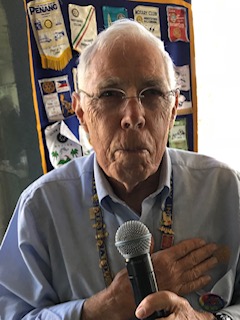 Chuck Osborne
Thought
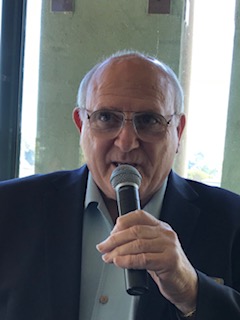 Bob Binn
“Speak in such as way that others will love to listen to you. Listen in such a way that others will love to speak to you.” Great, Bob. And to the point.
News
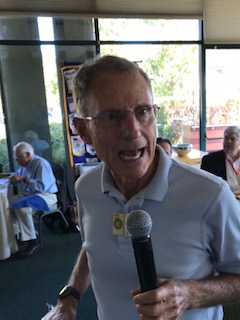 Martin Harband
Naked old man in a cape runs through the halls of the retirement home yelling, “Super sex, super sex!” Lady looks him over and says, “I’ll have the soup.”
Guests
Mitch Williams introduced his guest, whose name was not provided to Spinnings.
Visiting Rotarians
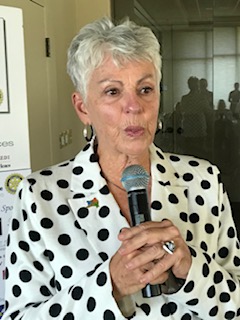
The usually adorable
Pam Frissella and her Foster City Rotary teammate,
Patricia Player Maxwell.Pam said John Kelly is in some financial difficulties and asked for a $90 gift to help him out. Oct. 29 is John’s birthday and she’s planning a little gift. Contributions may be made via the President’s Club and the Foundation.
Announcements
Oct. 24 is Polio Plus Day. Please buy your district raffle tickets: See Rosemary Azem.
Thursday, Oct. 25 is Youth in Government Day, which will start early at noon to accommodate the lengthy program. Plan to arrive early.
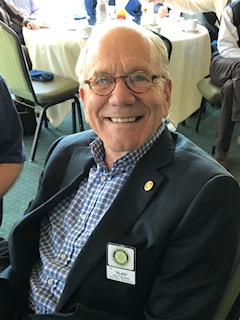 Fun Run: Alan Talansky
 reports it’ll raise more than $44,000. All the committee needs now is volunteers. See Alan to sign up.
EXTRA! PHOTO GALLERY